Search


Type
Grade Level
Social Justice Domain
Subject
Topic

1,950 Results

the moment

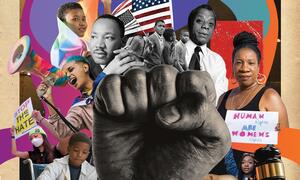
Expanding Democracy Through Intersecting Movements

In the continuing fight for justice and the expansion of democracy, understanding intersecting movements to end oppression is imperative and inspiring. Those at the intersections of geography, gender, poverty and race, as LFJ Director Jalaya Lyles Dunn explains, “will determine the fate of our democracy,” and have often been the agents of change, as witnessed by the connections between the past and the present highlighted in the Southern Poverty Law Center’s Civil Rights Memorial Center.

article

Why Our Students Need ‘Equity Literacy’

Several stacks of fake dollar bills enclosed in a Plexiglas case sit at the center of an exhibit entitled “RACE: Are We So Different?” at the National Museum of Natural History in Washington, D.C. One stack towers over the others. This teetering pile of bills represents the average net worth of “white” people’s assets in relation to those of other racialized groups based upon data collected by the U.S. Census Bureau from 1997 to 2000. While the “Asian” stack is almost as high, the “black” stack can hardly be called a stack at all; the “Latino” stack is almost as low.
Topic
article

Seeing All Kids as Our Kids

I’m constantly struck by the memory of my first time in a jail. It was during a tour as a part of SPLC’s efforts to monitor the conditions of detention facilities. I recall being shocked at how young some of the people looked. When I stepped into the first cellblock, I muttered a prayer. In front of me stood rows and rows of black men. I was sick to my stomach; so many of them looked like they could be my cousins, uncles and other loved ones.
article

Expanding Democracy

LFJ Director Jalaya Liles Dunn contends that “The treatment of children from communities experiencing systemic oppressions—those at the intersection of race, gender, poverty and geography—will determine the fate of our democracy.”
teaching strategy
Word Work

Vocabulary Frames

Students use this tool to identify a word’s meaning, its parts and its opposite. After organizing the information on an illustrated flashcard, students practice using the word in a sentence.
Grade Level
CCSS
L.6-12.4, L.6-12.6
July 19, 2014
teaching strategy
Word Work

Word Web

Word webs are mind maps that promote active learning and help students develop higher-order thinking skills. Students map their thinking in a graphic organizer based on a Frayer model.
Grade Level
3-5
CCSS
RL.3-5.4, RI.3-5.4, L.3-5.4, L.3-5.5, L.3-5.6
July 19, 2014