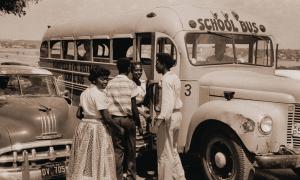
A powerful collection of Civil Rights-era photographs is on display now through August 2010 at the Bronx Museum of the Arts. If you can’t organize a class trip to the museum, consider taking your students on a virtual tour of the era.
The school-to-prison pipeline represents an intersection of complex issues, including race, class, education and the American justice system. Learn more by exploring the following research. Bibliography Bureau of Justice
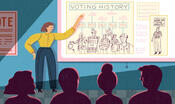
In this lesson, students learn about the expansion and restriction of voting rights in the United States, examine court rulings, discuss voter disengagement, and explore a voting rights timeline. Students will also learn how to register to vote.
Sarah Anderson teaches middle school humanities and interdisciplinary studies at a place-based charter school in Portland, Ore. Originally from rural Vermont, Anderson has also taught nature studies to urban middle school students in the California Redwoods, career skills to at-risk youth on an educational farm in Vermont and Civics and Global Studies at an independent school in Maryland. She earned a bachelor’s degree in American Studies at Bard College and a masters in education in Integrated Learning from Antioch New England Graduate School.
"Can Words Lead to War?" is an Inquiry Design Model (IDM), one of six sample IDMs that accompany the Teaching Hard History project. This inquiry provides students with an opportunity to explore how words affect public opinion through an examination of Harriet Beecher Stowe’s novel 'Uncle Tom’s Cabin.'
As Earth Day approaches, it’s a good time to think about how you approach issues of identity and diversity when it comes to the environment—regardless of the subject you teach. Here’s how one science teacher did it.